
Design and coordinate protective relay schemes that isolate only faulty components while keeping the rest of your system operational — ensuring continuous supply and maximum safety.
An effective protection scheme is the backbone of any reliable power system. It must isolate only the faulty component while leaving the rest of the system operational — a balance of selectivity, speed, sensitivity, and dependability that requires careful design and coordination.
A protection study — also known as protection and coordination study — is a detailed analysis of the protective devices (relays, circuit breakers, fuses) in your electrical system. Its purpose is to ensure that these devices are correctly sized, properly set, and accurately coordinated so that:
The consequences of inadequate or improperly coordinated protection are severe:
Miscoordinated protection causes widespread, unnecessary outages that disrupt operations and damage equipment through repeated fault current exposure.
Protection that is too slow or undersized fails to isolate faults, leading to catastrophic equipment damage, fires, and potential loss of life.
Hospitals, industrial plants, power transmission networks, and telecommunications infrastructure require the highest levels of protection reliability — a single failure can have devastating consequences.
Many jurisdictions require documented protection coordination studies. Failure to comply can invalidate insurance coverage and breach regulatory requirements.
Our protection studies follow a comprehensive methodology using industry-leading simulation software to model, analyse, and optimise your protection scheme:
Model the complete power and electrical network including generators, transformers, cables, breakers, and protective relays. Validate fault levels at every bus.
Analyse coordination between all protective devices in the system, verifying that selectivity is maintained under all fault conditions.
Calculate optimal pickup values, time dial settings, and curve types for all protective relays to achieve the required speed-selectivity trade-off.
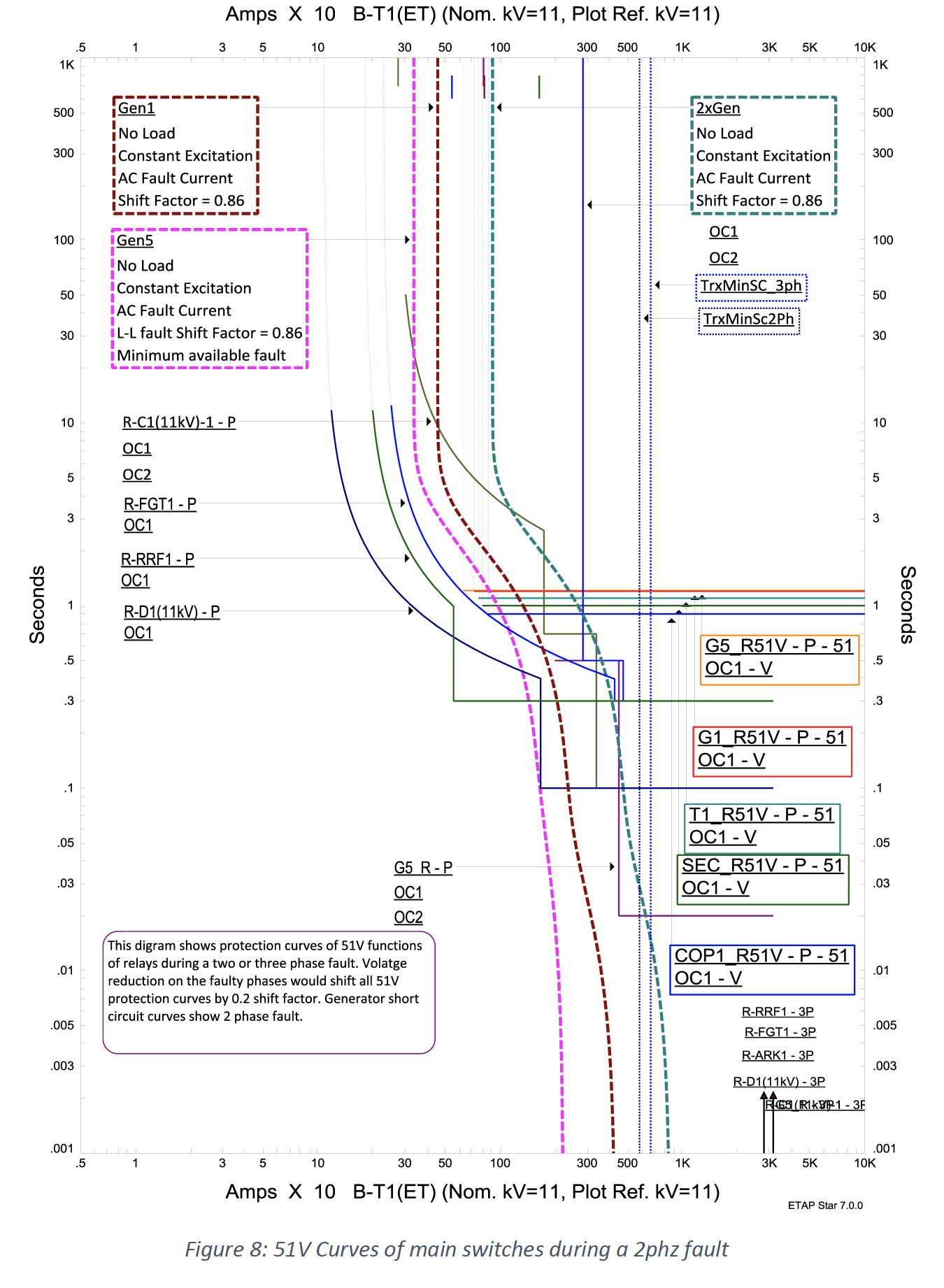
Produce Time-Current Curves (TCC) for all protective devices on a common log-log graph to visually verify coordination and demonstrate selectivity.
Our protection studies cover the full spectrum of protection engineering:
Protection coordination is where theory meets the real world. Our team brings extensive field experience — we've investigated nuisance trips in operating hospitals, redesigned protection schemes for critical transmission substations, and optimised relay settings for complex industrial plants with multiple generation sources.
Every protection study we deliver includes clear relay setting recommendations, updated TCC diagrams, and a practical implementation guide so your teams can apply our findings immediately.
Our team of power systems engineers is ready to provide expert guidance, detailed studies, and robust solutions tailored to your specific requirements.