
Steady-state voltage analysis and power distribution modelling to optimise your electrical network performance, plan expansion, and ensure system stability.
H‑Infinity conducts power flow studies during the planning and pre-engineering stages to identify problem areas, understand their implications, and deliver actionable recommendations for optimal network operation.
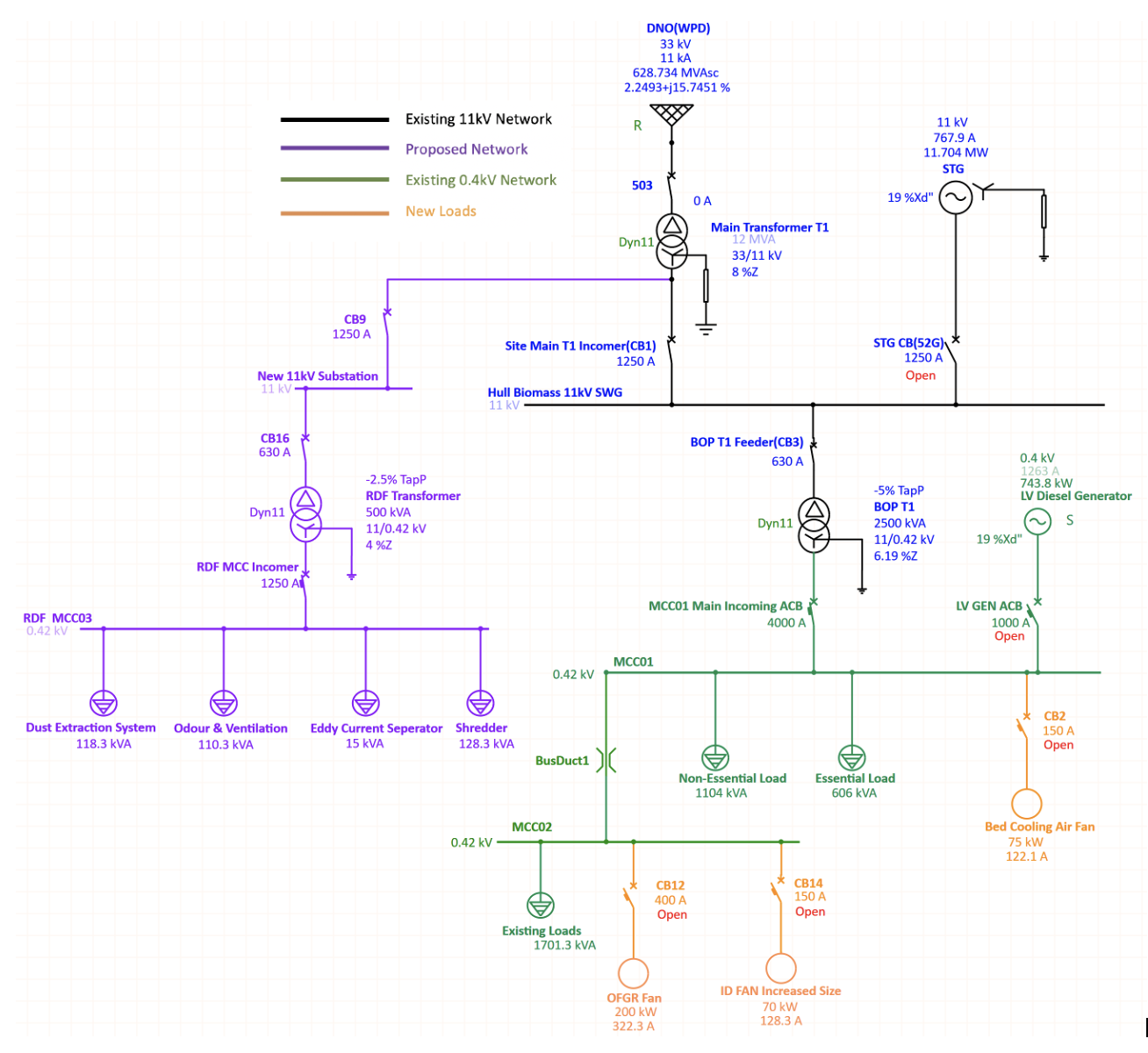
A power flow study — also known as a load flow analysis — is a fundamental electrical engineering analysis that determines the steady-state operating conditions of your power system. It calculates the voltage magnitude and phase angle at every bus (node) in the network, and the real and reactive power flowing through each transmission and distribution line.
The study creates a mathematical model of your entire electrical network — generators, transformers, transmission lines, cables, loads, and reactive power compensation equipment — and solves the underlying non-linear power balance equations using numerical methods such as Newton-Raphson, Gauss-Seidel, or Fast-Decoupled techniques.
Power flow analysis is essential for understanding and optimising your electrical infrastructure. It answers critical questions before they become costly problems:
Our power flow studies follow a structured, rigorous approach using industry-leading simulation platforms to ensure accuracy and reliability:
Gather complete network data — line parameters (R, X, B), transformer ratings and taps, generator capabilities, load profiles, and bus classifications.
Build a detailed one-line diagram model in simulation software, incorporating all network components with their operational parameters and constraints.
Run multiple operating scenarios — normal, peak load, minimum load, N-1 contingencies, and future expansion cases — to evaluate system behaviour across the full range of conditions.
Analyse voltage profiles, line loading, system losses, and reactive power flows. Deliver a comprehensive report with findings, visualisations, and actionable recommendations.
H‑Infinity brings years of hands-on experience in power system analysis to every study we undertake. Our team of engineers and data scientists combines deep domain expertise with advanced computational methods to deliver insights you can act on.
We don't just produce simulation outputs — we interpret them in the context of your specific operational environment, financial constraints, and strategic objectives. Our recommendations are practical, prioritised, and designed to deliver measurable value.
Our team of power systems engineers is ready to provide expert guidance, detailed studies, and robust solutions tailored to your specific requirements.