
Identify arc flash hazard levels, determine required PPE categories, establish protection boundaries, and ensure your electrical installations comply with arc flash safety standards.
An arc flash study identifies the amount of incident energy released during an electrical arc fault at each point in your system. This determines the hazard level, required personal protective equipment (PPE), and safe working distances — saving lives and ensuring regulatory compliance.
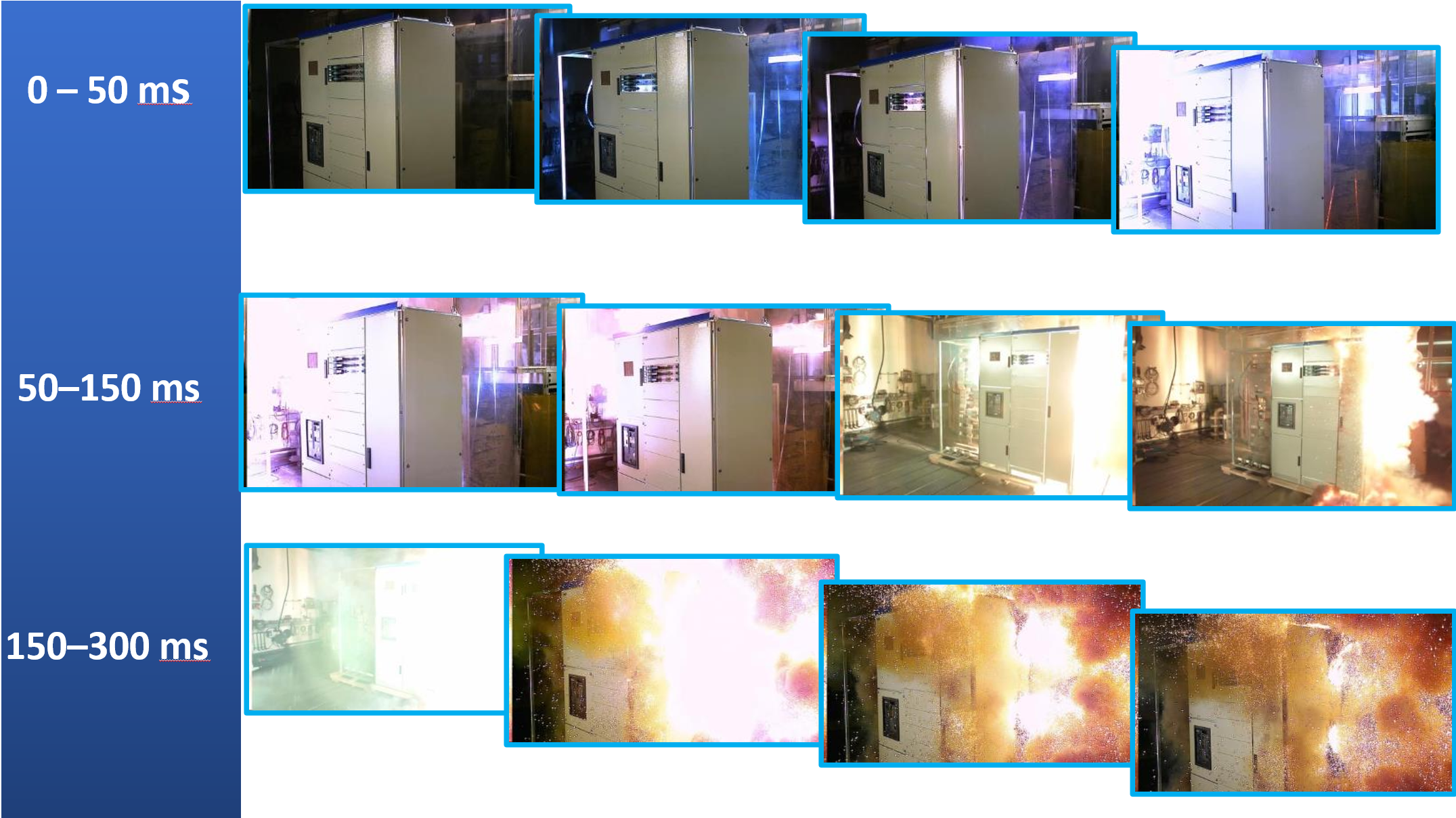
An arc flash is an unexpected release of electrical energy through the air, caused by insulation breakdown between conductive surfaces of different potential. It is one of the most dangerous events that can occur in any electrical system — temperatures can exceed 19,000°C (35,000°F), creating an explosive plasma ball that projects molten metal, intense heat, and a destructive pressure wave in every direction.
An arc flash study quantifies this danger by calculating the incident energy (measured in cal/cm²) at every piece of equipment throughout your installation. These calculations determine the arc flash boundary — the distance within which a worker would receive a second-degree burn — and the corresponding PPE category required for safe entry.
Arc flash incidents can be triggered by a variety of conditions and events:
Collect complete electrical system data — utility source, transformer ratings and impedances, cable lengths and sizes, protective device settings, and operating conditions. Validate with a thorough site survey.
Calculate the available fault current at each piece of equipment, considering the contribution from all sources including the utility, on-site generation, and motors.
Apply IEEE 1584 equations to calculate the incident energy at each point, factoring fault current, arc duration (determined by protective device clearing time), working distance, and arc type.
Assign arc flash PPE categories, establish protection boundaries, and produce compliant arc flash labels for every piece of equipment per NFPA 70E requirements.
H‑Infinity provides thorough arc flash studies backed by decades of field experience. Our approach combines detailed simulation modelling with practical site assessment to deliver results you can act on immediately.
We don't just hand you a report — we provide clear, colour-coded arc flash labels ready for application, comprehensive training materials for your electrical teams, and a prioritised action plan to reduce arc flash energy where feasible through protective device adjustments and system modifications.
Our team of power systems engineers is ready to provide expert guidance, detailed studies, and robust solutions tailored to your specific requirements.